How Do You Know if the Heating Element Is Bad in My Dryer

A modern forepart-load tumble clothes dryer for dwelling house awarding
A clothes dryer, besides known as tumble dryer or simply dryer, is a powered household appliance that is used to remove moisture from a load of clothing, bedding and other textiles, normally shortly after they are washed in a washing machine.
Many dryers consist of a rotating drum called a "tumbler" through which heated air is circulated to evaporate the wet, while the tumbler is rotated to maintain air space between the articles. Using these machines may crusade apparel to shrink or become less soft (due to loss of short soft fibers). A simpler not-rotating machine called a "drying cabinet" may be used for delicate fabrics and other items not suitable for a tumble dryer.
Drying at a minimum of 60 °C (140 °F) oestrus for thirty minutes kills many parasites including house grit mites,[one] bedbugs,[2] and scabies mites[3] and their eggs; a bit more than 10 minutes kills ticks.[4] Merely washing drowns dust mites and exposure to straight sunlight for three hours kills their eggs.[one]
Combination washer-dryers perform both functions in one device.
Others include steam to de-shrink clothes and avoid ironing.[five]
Tumble dryers [edit]
Tumble dryers continuously draw in the ambient air around them and heat information technology before passing information technology through the tumbler. The resulting hot, humid air is unremarkably vented outside to make room for more air to proceed the drying process. Information technology is uncomplicated and reliable, and therefore has been widely used.
Improvised methods of salvaging this heat for in-home heating, past use of inline vent boxes equipped with Air Damper to redirect moist heated air to indoor areas, will also increase humidity within a dwelling. Although this may be beneficial in dry winter conditions, excess humidity from these devices increases likelihood of mold, mildew, and bacterial growth inside a dwelling house. Indoor venting may also be against local regulations. Gas dryers, unlike electric dryers, must always be vented outdoors, as the products of combustion are mixed with the moist air. Building codes and manufacturers' instructions usually recommended that dryers vent outdoors. An indoor lint trap kit poses a similar business of increased humidity within the dwelling.[ farther caption needed ]
"Long run" dryers might have an additional external frazzle fan to boost the exiting moist air through longer sections of vent pipe, as in apartments or dwellings where the vent cannot make a short direct connection from the dryer to the exterior.
Beyond issues with venting exhaust, other improvised efficiency efforts with conventional dryers attempt to harvest an input source of pre-heated air rather than using the conditioned air of the living infinite. One notable source of heat to pre-rut dryer air is to install ductwork assuasive the device to suck hot air from a domicile's attic.[ citation needed ]
Tumble dryers are frequently integrated with a washing auto, in the form of laundry centers and washer-dryer combos, which stacks the dryer on summit of the washer and integrates the controls for both machines in a unmarried control panel, or in the grade of "washer-dryer combos" which are essentially a front loading washing automobile with an integrated dryer. Often the washer and dryer functions volition have a different capacity, with the dryer usually having a lower capacity than the washer. Tumble dryers can also be meridian loading, in which the drum is loaded from the peak of the machine and the drum's ends are in the left and correct sides, instead of the more conventional front and rear. They tin be as thin as forty cm in width, and may include detachable racks for drying items like plush toys and footwear.[half dozen]
Ventless dryers [edit]
Spin dryers [edit]

These centrifuge machines but spin their drums much faster than a typical washer could, in social club to excerpt additional water from the load. They may remove more water in two minutes than a heated tumbler dryer can in twenty, thus saving significant amounts of time and energy. Although spinning solitary will not completely dry out article of clothing, this additional stride saves a worthwhile amount of time and free energy for large laundry operations such as those of hospitals.
Condenser dryers [edit]
Just as in a tumble dryer, condenser or condensation dryers laissez passer heated air through the load. Yet, instead of exhausting this air, the dryer uses a heat exchanger to cool the air and condense the water vapor into either a drain pipe or a collection tank. The drier air is run through the loop again. The rut exchanger typically uses ambient air as its coolant, therefore the rut produced by the dryer volition become into the immediate surroundings instead of the outside, increasing the room temperature. In some designs, cold water is used in the heat exchanger, eliminating this heating, but requiring increased water usage.
In terms of energy use, condenser dryers typically require around ii kilowatt hours (kW⋅h) of energy per boilerplate load.[7]
Because the oestrus exchange procedure simply cools the internal air using ambient air (or cold water in some cases), it will not dry the air in the internal loop to equally depression a level of humidity every bit typical fresh, ambient air. As a issue of the increased humidity of the air used to dry the load, this type of dryer requires somewhat more fourth dimension than a tumble dryer. Condenser dryers are a particularly bonny pick where long, intricate ducting would be required to vent the dryer.
Heat pump dryers [edit]
A airtight-wheel oestrus pump dress dryer uses a heat pump to dehumidify the processing air. Such dryers typically use under half the energy per load of a condenser dryer.
Whereas condensation dryers use a passive heat exchanger cooled by ambient air, these dryers use a heat pump. The hot, humid air from the tumbler is passed through a heat pump where the cold side condenses the h2o vapor into either a drain pipe or a collection tank and the hot side reheats the air afterwards for re-employ. In this way not only does the dryer avert the need for ducting, but it besides conserves much of its oestrus within the dryer instead of exhausting information technology into the surroundings. Estrus pump dryers tin, therefore, use up to l% less free energy required past either condensation or conventional electrical dryers. Estrus pump dryers use about 1 kW⋅h of energy to dry an average load instead of 2 kW⋅h for a condenser dryer, or from three to 9 kW⋅h, for a conventional electric dryer.[8] [9] [7] Domestic heat pump dryers are designed to work in typical ambient temperatures from 5 to 30 °C. Below 5 °C, drying times significantly increase.
As with condensation dryers, the heat exchanger volition not dry out the internal air to every bit low a level of humidity as the typical ambience air. With respect to ambience air, the higher humidity of the air used to dry the clothes has the upshot of increasing drying times; however, because heat pump dryers conserve much of the heat of the air they apply, the already-hot air tin can exist cycled more than rapidly, possibly leading to shorter drying times than tumble dryers, depending on the model.
Mechanical steam compression dryers [edit]
A new type of dryer in development, these machines are a more than advanced version of heat pump dryers. Instead of using hot air to dry the clothing, mechanical steam compression dryers employ water recovered from the clothing in the course of steam. First, the tumbler and its contents are heated to 100 °C. The wet steam that results purges the system of air and is the merely remaining atmosphere in the tumbler.
Every bit wet steam exits the tumbler, it is mechanically compressed (hence the name) to extract water vapor and transfer the estrus of vaporization to the remaining gaseous steam. This pressurized, gaseous steam is then allowed to aggrandize, and is superheated before being injected dorsum into the tumbler where its heat causes more water to vaporize from the clothing, creating more wet steam and restarting the bicycle.
Similar heat pump dryers, mechanical steam pinch dryers recycle much of the heat used to dry the clothes, and they operate in a very similar range of efficiency as heat pump dryers. Both types can exist over twice equally efficient as conventional tumble dryers. The considerably college temperatures used in mechanical steam pinch dryers upshot in drying times on the society of one-half equally long as those of heat pump dryers.[10]
Convectant drying [edit]
Marketed by some manufacturers equally a "static dress drying technique", convectant dryers simply consist of a heating unit at the lesser, a vertical bedroom, and a vent at superlative. The unit heats air at the bottom, reducing its relative humidity, and the natural tendency of hot air to ascension brings this depression-humidity air into contact with the clothes. This design is wearisome, just relatively energy-efficient. It is only marginally faster than line-drying.
Solar dress dryer [edit]
The solar dryer is a box-shaped stationary construction which encloses a 2d compartment where the apparel are held. It uses the sun's estrus without straight sunlight reaching the clothes. Alternatively, a solar heating box may be used to rut air that is driven through a conventional tumbler dryer.
Microwave dryers [edit]
Japanese manufacturers[ citation needed ] have developed highly efficient clothes dryers that utilize microwave radiation to dry out the dress (though a vast majority of Japanese air dry their laundry). Most of the drying is done using microwaves to evaporate the water, but the final drying is washed by convection heating, to avoid problems of arcing with metal pieces in the laundry. There are a number of advantages: shorter drying times (25% less),[11] free energy savings (17–25% less), and lower drying temperatures. Some analysts remember that the arcing and fabric impairment is a factor preventing microwave dryers from being developed for the United states market.[12] [13]
Ultrasonic dryers [edit]
Ultrasonic dryers use high-frequency signals to drive piezoelectric actuators in guild to mechanically shake the dress, releasing water in the form of a mist which is and so removed from the pulsate. They have the potential to significantly cut energy consumption while needing only i-tertiary of the time needed by a conventional electric dryer for a given load.[14] They also practise not have the same issues related with lint in most other types of dryers.[15]
Hybrid dryers [edit]
Some manufacturers, like LG Electronics and Whirlpool, take introduced hybrid dryers, that offer the user the option of using either a estrus pump or a traditional electrical heating element for drying the user's wearing apparel. Hybrid dryers can besides use a estrus pump and a heating element at the aforementioned time to dry out clothes faster.
Static electricity [edit]
Clothes dryers can cause static cling, through the triboelectric effect. This can be a minor nuisance and is often a symptom of over-drying textiles to an extremely low humidity level. Cloth conditioners and dryer sheets are marketed to right this condition.
History [edit]
A manus-cranked dress dryer was created in 1800 past Thousand. Pochon from France.[xvi] Henry West. Altorfer invented what is probable the beginning electric clothes dryer in 1937.[17] J. Ross Moore, an inventor from North Dakota, developed designs for automatic clothes dryers during the early 20th century. His pattern for an electrically operated dryer was developed and released to the public in 1938.[eighteen] Industrial designer Brooks Stevens developed the first electric dryer with a glass window in the 1940s.[19]
Lint build-up (tumble dryers) [edit]
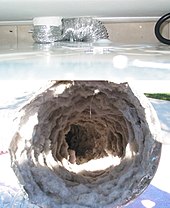
Upper image shows a severely kinked and blocked dryer transition hose used to vent a tumble dryer. In this instance, the dryer was located or pushed back too far against the wall. The lower image shows initial lint build-up in the flex transition hose.
Wet and lint are byproducts of the tumble drying process and are pulled from the pulsate by a fan motor and so pushed through the remaining frazzle conduit to the exterior termination fitting. Typical exhaust conduit comprises flex transition hose found immediately behind the dryer, the 4-inch (100 mm) rigid galvanized pipe and elbow fittings found within the wall framing, and the vent duct hood constitute outside the house.
A clean, unobstructed dryer vent improves the safety and efficiency of the dryer. Every bit the dryer duct pipage becomes partially obstructed and filled with lint, drying fourth dimension increases and causes the dryer to overheat and waste energy. In farthermost cases, a blocked vent may result in a fire. Dress dryers are one of the more costly home appliances to operate.[20]
Several factors can contribute to or accelerate rapid lint build-up. These include long or restrictive ducts, bird or rodent nests in the termination, crushed or kinked flex transition hose, terminations with screen-like features, and condensation within the duct due to un-insulated ducts traveling through cold spaces, such as a crawl space or attic. If plastic flaps are at the exterior end of the duct, one may be able to flex, curve, and temporarily remove the plastic flaps, clean the inside surface of the flaps, clean the concluding foot or then of the duct, and reattach the plastic flaps. The plastic flaps keep insects, birds, and snakes[21] out of the dryer vent piping. During cold weather condition, the warm wet air condenses on the plastic flaps, and minor trace amounts of lint sticks to the wet inside part of the plastic flaps at the outside of the building.[22] [23]

Home clothes dryer outside vent outlet. Flaps can be removed for cleaning of the flaps and duct.
Ventless dryers include multi-phase lint filtration systems and some fifty-fifty include automatic evaporator and condenser cleaning functions that can run even while the dryer is running. The evaporator and condenser are usually cleaned with running h2o. These systems are necessary, in social club to preclude lint from edifice upward inside the dryer and evaporator and condenser coils.
Safety [edit]
Dryers expose flammable materials to heat. Underwriters Laboratories[24] recommends cleaning the lint filter after every cycle for rubber and energy efficiency, provision of adequate ventilation, and cleaning of the duct at regular intervals.[25] UL likewise recommends that dryers non be used for glass fiber, rubber, foam or plastic items, or whatsoever detail that has had a flammable substance spilled on information technology.
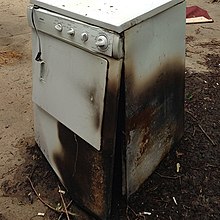
A clothes dryer that has been damaged by fire
In the U.s., the U.S. Burn down Administration[26] in a 2012 report estimated that from 2008 to 2010, fire departments responded to an estimated 2,900 clothes dryer fires in residential buildings each year beyond the nation. These fires resulted in an annual average loss of v deaths, 100 injuries, and $35 million in property loss. The Fire Administration attributes "Failure to clean" (34%) equally the leading factor contributing to clothes dryer fires in residential buildings, and observed that new home construction trends place apparel dryers and washing machines in more chancy locations away from exterior walls, such as in bedrooms, second-floor hallways, bathrooms, and kitchens.
To address the trouble of clothes dryer fires, a burn suppression arrangement tin exist used with sensors to observe the change in temperature when a blaze starts in a dryer pulsate. These sensors then actuate a water vapor mechanism to put out the fire.[27]
Environmental impact [edit]
The ecology bear upon of clothes dryers is especially severe in the The states and Canada, where over lxxx% of all homes have a clothes dryer. Co-ordinate to the Usa Environmental Protection Agency, if all residential clothes dryers sold in the U.S. were free energy efficient, "the utility cost savings would grow to more than $1.5 billion each yr and more than 22 billion pounds [10 billion kilograms] of annual greenhouse gas emissions would be prevented".[28]
Apparel dryers are 2d simply to refrigerators and freezers equally the largest residential electric energy consumers in America.[29]
In the European Union, the EU free energy labeling system is applied to dryers; dryers are classified with a label from A+++ (best) to Yard (worst) according to the amount of energy used per kilogram of apparel (kW⋅h/kg). Sensor dryers can automatically sense that wearing apparel are dry and switch off. This means over-drying is not as frequent. Most of the European market place sells sensor dryers now, and they are normally available in condenser and vented dryers.
Come across also [edit]
- Laundry-folding car
- Listing of habitation appliances
- Sheila Maid
- Shoe dryer
- Surge protector
References [edit]
- ^ a b Mahakittikun, 5; Boitano, JJ; Ninsanit, P; Wangapai, T; Ralukruedej, K (Dec 2011). "Effects of high and low temperatures on development time and mortality of house dust mite eggs". Experimental & Applied Acarology. 55 (4): 339–47. doi:10.1007/s10493-011-9480-two. PMID 21751035.
- ^ Ibrahim, O; Syed, UM; Tomecki, KJ (March 2017). "Bedbugs: Helping your patient through an infestation". Cleveland Clinic Journal of Medicine. 84 (3): 207–211. doi:10.3949/ccjm.84a.15024. PMID 28322676.
- ^ Prevention, CDC-Centers for Disease Control and (April 19, 2019). "CDC - Scabies - Treatment". CDC.gov.
- ^ Schlanger, Zoë. "Lyme Illness Season Is Hither. These Are Tips on How to Avoid Information technology". The New York Times.
- ^ "How can you lot launder and dry clothes with steam?". HowStuffWorks. June thirty, 2008.
- ^ "Using the Dryer Rack - LG Dryer | LG United states Support". LG Us.
- ^ a b "Miele TDA 140 C T Classic condenser tumble dryer". one thousand.miele.co.uk . Retrieved four April 2018.
- ^ "Miele TDB120WP Eco T1 Archetype heat-pump tumble dryer". 1000.miele.co.u.k.. Archived from the original on 19 February 2018. Retrieved 4 April 2018.
- ^ "Clothes Dryer Energy Apply - Running Costs Explained – Canstar Blue". canstarblue.com.au. 3 July 2017. Retrieved 4 April 2018.
- ^ "Archived re-create" (PDF). Archived from the original (PDF) on 2011-07-20. Retrieved 2010-11-06 .
{{cite web}}: CS1 maint: archived re-create as title (link) - ^ "Flex Your Power - Residential Production Guides". six March 2012. Archived from the original on six March 2012. Retrieved 4 Apr 2018.
- ^ Gerling, J. Microwave Wearing apparel Drying – Technical Solutions to a Fundamental Challenges. Appliance Magazine, April 2003. http://www.appliancemagazine.com/editorial.php?article=150&zone=first=one Archived 2014-05-24 at the Wayback Motorcar
- ^ Levy, Clifford J. (September 15, 1991). "Tech Notes; Using Microwaves to Dry out Clothes". The New York Times.
- ^ Mueller, Mike (2017-04-12). "No Heat? No Problem: This Ultrasonic Dryer Dries Dress in Half the Time". Office of Energy Efficiency & Renewable Energy. Archived from the original on 2017-04-xviii. Retrieved 2021-06-09 .
- ^ Momem, Ayyoub Thousand. "Novel Ultra-Depression-Energy Consumption Ultrasonic Clothes Dryer". U.s.a. Department of Energy . Retrieved twenty April 2017.
- ^ Binggeli, Corky (2003). Building Systems for Interior Designers . Wiley. p. 264. ISBN978-0-471-41733-0 . Retrieved 2009-10-04 .
- ^ "Patent US2137376A". Google Patents.
- ^ Acton, Johnny; Adams, Tania; Packer, Matt (2006). The origin of everyday things . New York: Sterling. pp. 247. ISBN1402743025.
- ^ Brooks Stevens, Wisconsin Historical Society, retrieved 2009-10-04
- ^ Domicile Apparatus Energy Utilise, General Electric, archived from the original on 2010-08-22, retrieved 2010-08-23
- ^ Didlake, Brian (March 24, 2021). "'In that location's a dead snake in there:' Florida family finds snake snarled up in dryer". WKMG.
- ^ "Technical Production Specifications | Deflect-O" (PDF). www.deflecto.com. Archived from the original (PDF) on 9 May 2015.
- ^ "Technical Product Specifications | Deflect-O Hardware" (PDF). world wide web.deflecto.com. Archived from the original (PDF) on 9 May 2015.
- ^ "Underwriters Laboratories". Archived from the original on 2008-02-22. Retrieved 2008-02-13 .
- ^ Underwriters Laboratories product prophylactic tips - wearing apparel dryers Archived 2014-03-05 at the Wayback Machine.
- ^ "Clothes Dryer Fires in Residential Buildings (2008-2010)" (PDF). FEMA.
- ^ careinfo.org Archived 2011-10-xx at the Wayback Machine, New S.A.F.Due east. system tackles safety problem of fires in laundry dryers Archived 2017-05-01 at the Wayback Automobile , November 2001. Accessed ten October 2011.
- ^ "EPA adds clothes dryers to Energy Star program". Press release EPA
- ^ "Emerging Technologies: A Case Study of the Super Efficient Dryers Initiative". ACEEE.org
External links [edit]
- "What You Should Know About Clothes Dryers." Popular Mechanics, December 1954, pp. 170–175, bones principles of dryers even today.
How Do You Know if the Heating Element Is Bad in My Dryer
Source: https://en.wikipedia.org/wiki/Clothes_dryer
0 Response to "How Do You Know if the Heating Element Is Bad in My Dryer"
Post a Comment